College Football 4th Down Decision Tool
Mar 10, 2025.
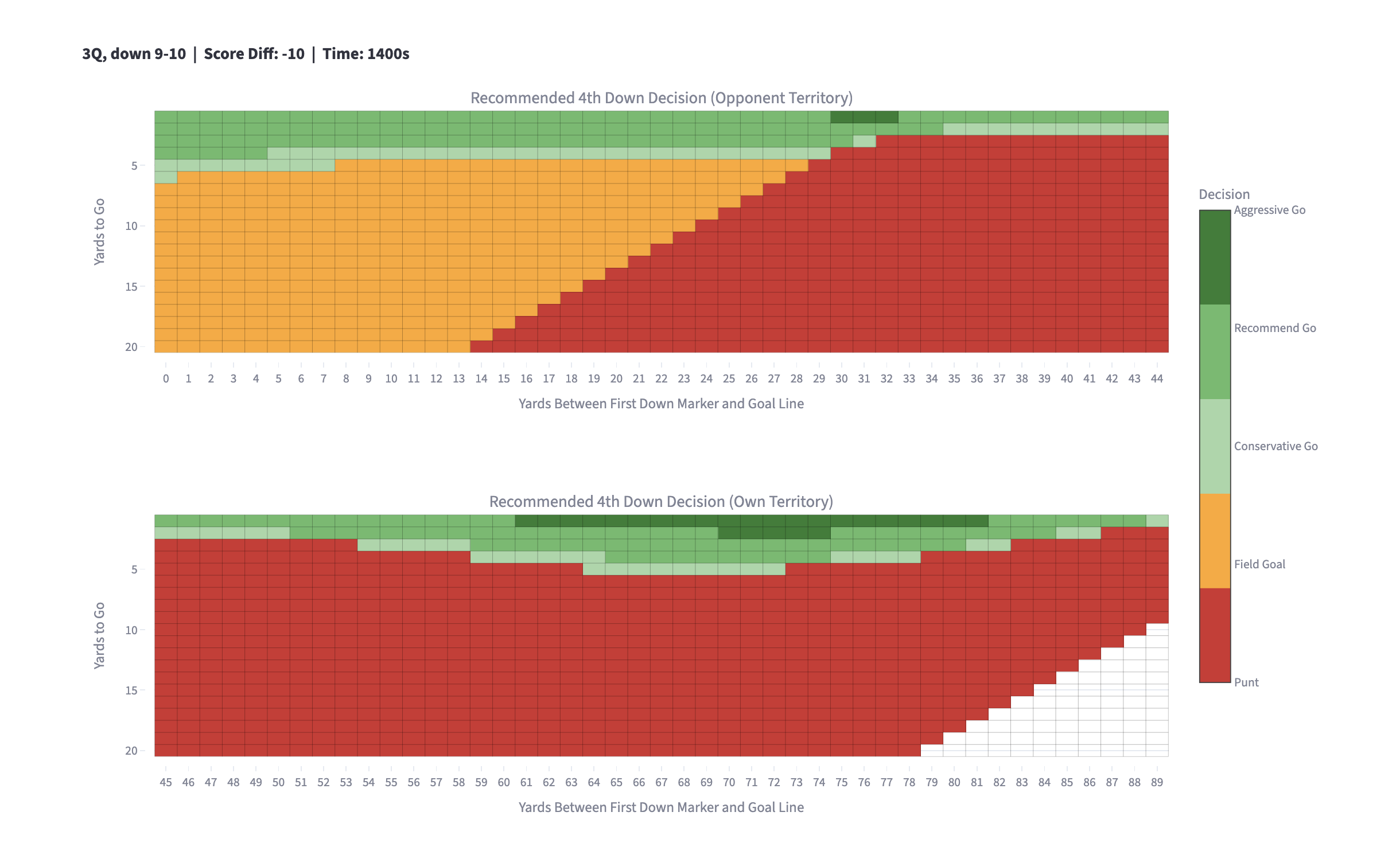
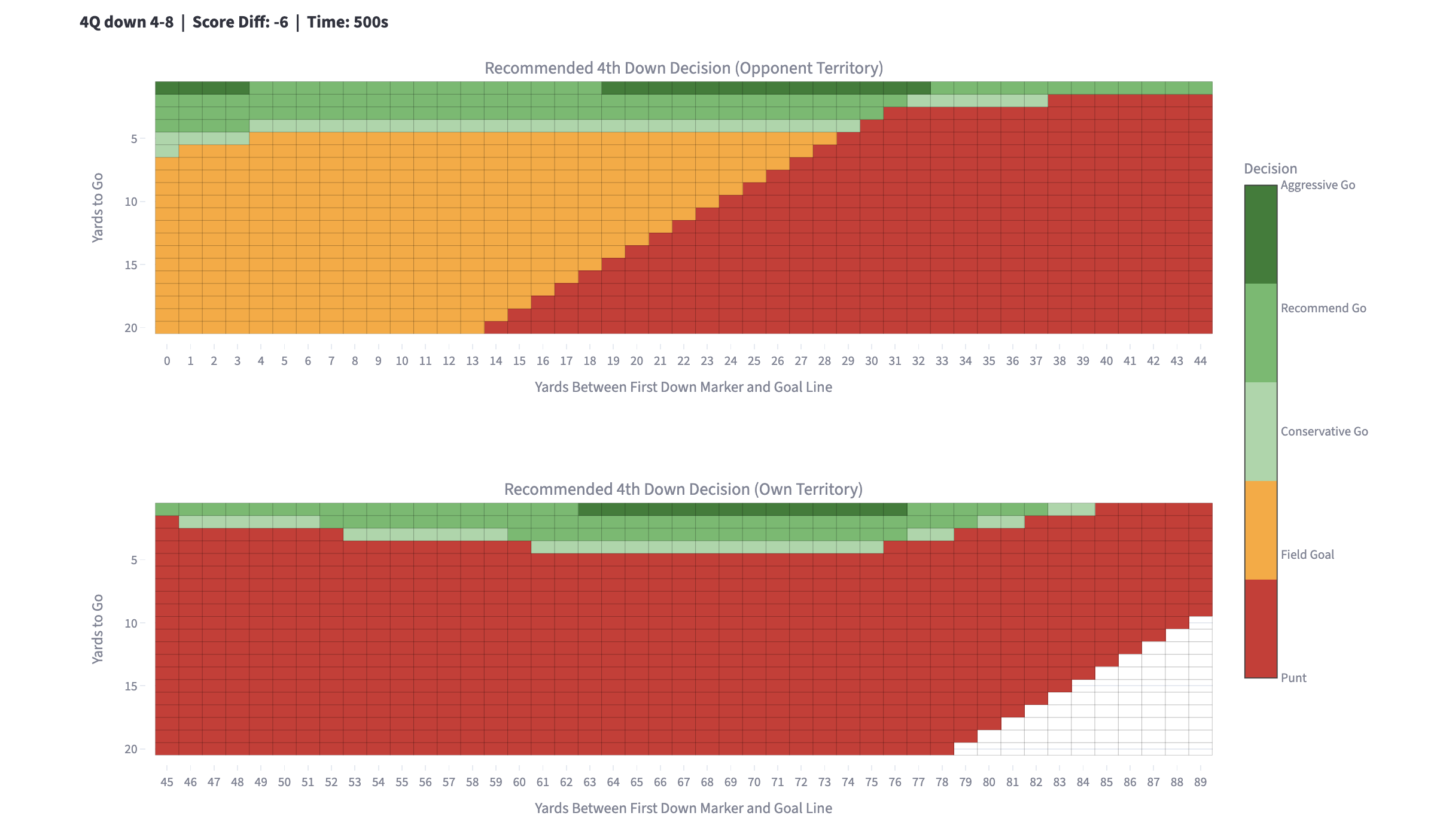
This project focused on developing an interactive data-driven decision support tool for fourth down situations in college football. Rather than relying on intuition or traditional coaching tendencies, the goal was to use historical play-by-play data and statistical modeling to recommend whether a team should punt, attempt a field goal, or go for the first down. The final product was an interactive application that generates decision heatmaps for thousands of game situations while allowing users to explore the underlying probabilities through an intuitive visualization.
The project began with collecting and cleaning play-by-play data from the 2024 NCAA Football Bowl Subdivision (FBS) season. Data preprocessing was one of the most important stages of the project because raw football data contains inconsistencies, missing values, and variables that are not useful for predictive modeling. New features were engineered to better describe the game state, including score differential, time remaining, field position, yards to gain, timeout counts, and distance to the goal line. These variables represent the contextual information that coaches evaluate during a fourth down decision and served as the predictors for the model.
Several predictive models were explored before selecting the final approach. Logistic regression models were trained to estimate the probability of successfully converting a fourth down attempt, making a field goal, or achieving favorable outcomes after a punt. Multiple machine learning techniques, including neural networks and random forests, were also investigated to determine whether more complex models could improve predictive accuracy. Model performance was evaluated using standard machine learning principles such as training and testing data separation, feature scaling, cross-validation, and overfitting analysis. Simpler models often performed competitively while providing greater interpretability, making them better suited for decision support.
Once reliable probability estimates were obtained, the project shifted toward decision analytics. Rather than selecting the action with the highest probability of immediate success, each possible decision was evaluated using expected outcomes. A threshold-based framework was implemented to account for different coaching philosophies and risk tolerances. Conservative thresholds favored punts or field goals unless going for it provided a substantial advantage, while aggressive thresholds recommended fourth down attempts more frequently. By averaging recommendations across multiple thresholds, the application categorizes decisions into levels of confidence, allowing users to distinguish between situations where going for it is merely reasonable and those where it is strongly recommended.
Visualization played a significant role in making the analytical results understandable. Using Plotly and Streamlit, interactive heat maps were created to display recommended decisions across combinations of field position and yards to gain. Hover functionality provides users with the underlying probabilities for each decision option, allowing coaches and analysts to understand why a recommendation was made instead of treating the model as a "black box." This transparency is an important principle in modern analytics because interpretable models are generally more trustworthy and actionable than opaque predictions.
From a data analytics perspective, the project demonstrates several core principles. It emphasizes the importance of data cleaning, feature engineering, predictive modeling, model validation, and interactive visualization. It also highlights how domain knowledge can be combined with statistical methods to solve practical decision-making problems. Rather than simply predicting outcomes, the project transforms predictive analytics into prescriptive analytics by recommending the action most likely to maximize success under varying game conditions.
Overall, this project illustrates how modern data analytics can improve strategic decision-making in sports. By integrating historical data, machine learning, probability modeling, and interactive visualization into a single application, the resulting decision support system provides coaches and analysts with objective, evidence-based recommendations that complement traditional football expertise.